Wird geladen...
Wird geladen...
An open account of the level of maturity: which properties of our materials are substantiated, which evidence is still being produced and how responsibility is divided between supplier and system manufacturer.
Development status & documentation
We are currently building up this area. The materials are proven; the application in storage system construction is new to us. This page states where we stand — so that you can judge what you can rely on and what not yet.
The material side is substantiated: mineral-bonded, non-combustible, in high-temperature service for decades, with material certificates and documented installation practice. In progress are the application-specific items of evidence — the formal fire classification to DIN EN 13501-1 as well as characteristic values for thermal conductivity and moisture behaviour for storage system construction.
Certification of the storage system is not within our area of responsibility. The propagation test to IEC 62619, safety testing to VDE-AR-E 2510-2, EMC and CE conformity concern the overall system and are handled by the manufacturer with the test institute. We supply the input data for our own scope of work.
Proven methods and specialised equipment for optimal results.
The castables used are mineral and cement-bonded. They contribute no fire load — that is a material property, not a forecast.
Refractory linings have been our daily business for more than 35 years, with in-house installation teams and documented execution.
Thermal conductivity in the operating temperature range, water absorption and freeze-thaw behaviour are determined on a project basis.
Propagation test, EMC, CE conformity and building approval at the installation site lie outside our scope of work.
Structured, transparent and on schedule — this is how we work.
Specification for the specific application: capacity class, installation site, ambient conditions.
Without this definition, neither the material nor the scope of testing can be determined sensibly.
Comparison of the available castables against the requirements profile, requesting missing laboratory values.
The result is a reasoned shortlist showing the substantiated and open properties for each candidate.
Clarification of the interfaces with racks, cooling, cable routing and fixings.
Carried out under a confidentiality agreement where required, as design data is involved.
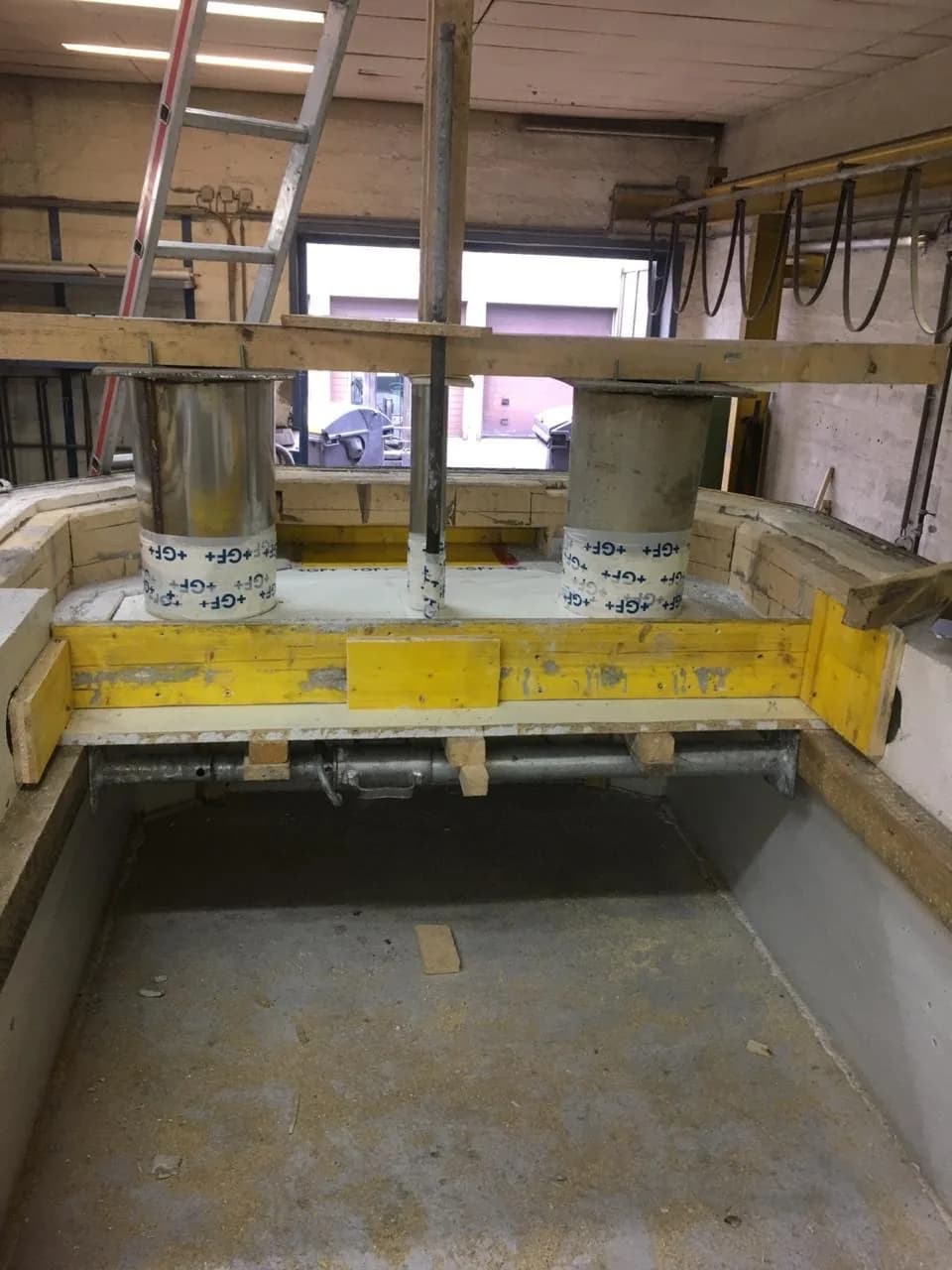
Sample component or wall segment at 1:1 scale.
The basis for practical assessment and for a sound go/no-go decision.
Provision of the material certification and its place within the manufacturer's system testing.
A non-binding preliminary discussion with VDE or TÜV on the testing strategy is advisable at this point.
Proper separation, recovery and disposal of all resulting materials.
Manufacturer certificates for the castables used, part of the documentation as in any furnace project.
Documentation of the execution with layer thicknesses, processing conditions and acceptance.
Formal evidence of class A1 for the castables used in storage system construction.
Propagation test, safety and EMC testing of the overall system — outside our scope of supply and responsibility.
Typical situations in which Development status & documentation is used.
A technical assessment of a potential supplier is due
Clarification of which evidence is to be provided by whom
Preparation of a pilot project
Agreeing the testing strategy with a test institute
Assessing the level of maturity ahead of a tender
An internal decision paper on a possible collaboration
Everything you need to know about Development status & documentation
Your question not listed?
Request a personal consultationWhether complete relining, repair or emergency — free initial consultation and a fast response.