
Wird geladen...
Wird geladen...
Cell separations are non-combustible components that separate individual modules or rack levels from one another. The aim is to delay the spread of a thermal event to neighbouring units.
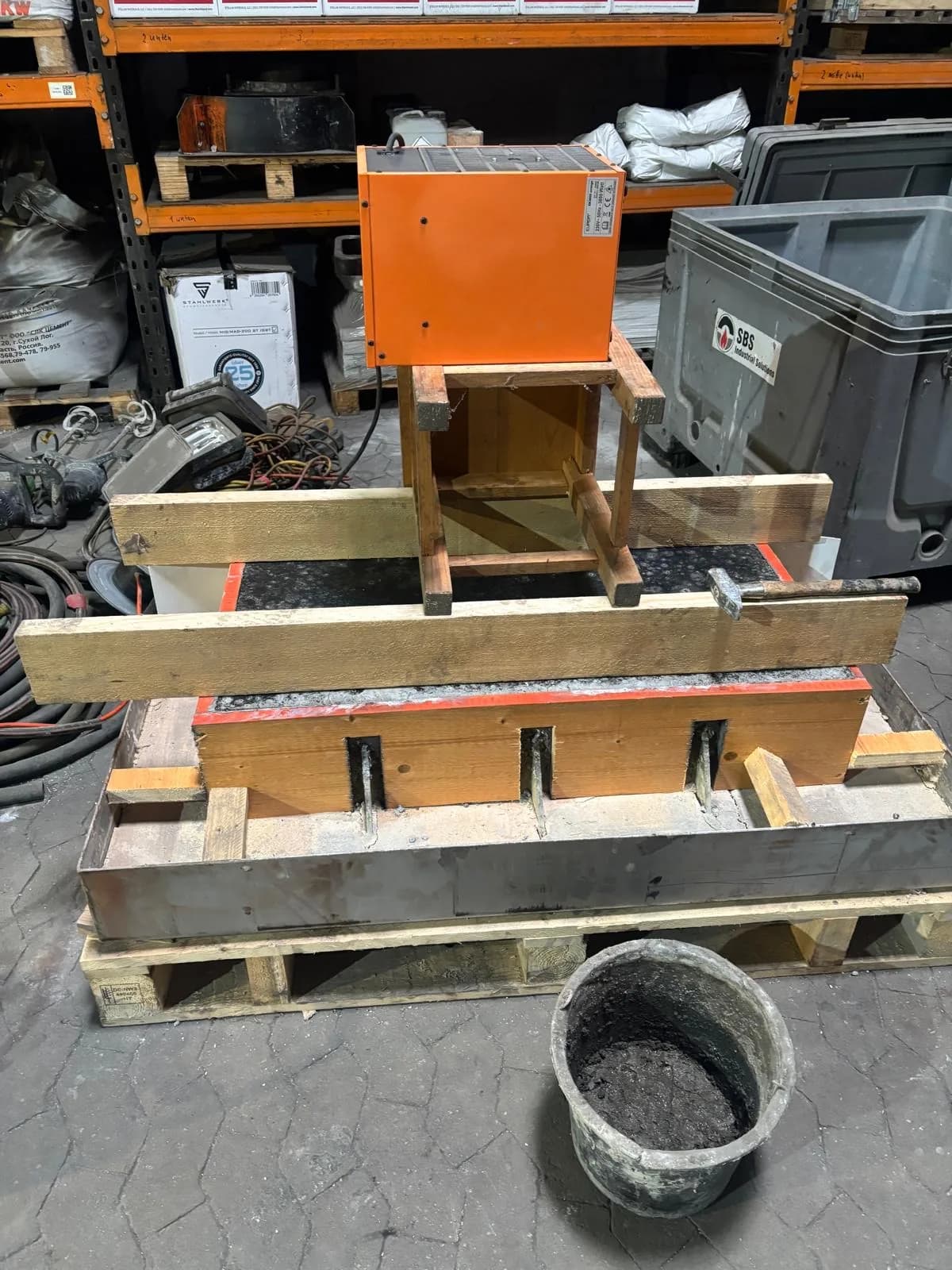
Cell separation & partition elements
The critical case in a battery storage system is not the single defective cell, but the chain reaction affecting its neighbours. In design terms this is addressed through spacing, cooling, pressure relief — and through partition elements between the modules.
Mineral materials are an obvious choice for such partition elements: they do not burn, contribute no fire load and retain their shape even when things get hot. That is precisely the property for which we have been using our castables in furnace construction for decades.
An important qualification: whether a given construction actually prevents propagation is decided by the propagation test on the complete system to IEC 62619 — not by the material alone. We supply the component and its characteristic values; the system-level evidence is provided by the manufacturer.
Proven methods and specialised equipment for optimal results.
Prefabricated panels of defined thickness, fitted between module levels. Manufactured to size so that they fit into existing rack grids.
Components with cut-outs for cables, cooling and fixings — manufactured to your design drawing.
Cast or bricked partition walls between storage blocks in fixed installations, for example in plant rooms or storage buildings.
A combination of mineral panels with ceramic fibre insulation where heat transfer is also to be reduced.
Structured, transparent and on schedule — this is how we work.
Recording of the rack grid, module spacing and fixing points.
Without reliable dimensions, no partition element can be designed that can later actually be installed.
Definition of geometry, thickness, cut-outs and fixings.
Coordinated with your design — including tolerances for manufacture and installation.
Manufacture of individual elements for practical assessment.
You check fit, weight and handling in your actual rack before series production starts.
Provision of the material characteristic values for your system-level evidence.
Testing of propagation resistance takes place on the complete system at the test institute — we supply the input data for it.
Manufacture and delivery to your assembly line.
On request with batch documentation for each delivery.
Proper separation, recovery and disposal of all resulting materials.
Prefabricated, dimensionally accurate panels made from cement-bonded castable — the basic form of cell separation.
Reduces heat transfer between the separated areas in addition to the mineral barrier.
Can be trowelled and gunned, suitable for edge protection and for application onto existing partition structures.
Fused silica castable from our own production — for components with particular demands on thermal shock resistance.
Typical situations in which Cell separation & partition elements is used.
Propagation protection between modules is to be supplemented by design measures
The test institute requires non-combustible separating levels in the construction
An existing rack system is to be retrofitted
Storage blocks in plant rooms need to be separated from one another
The insurer requires additional structural separation
A system manufacturer's in-house development needs a supplied component
Everything you need to know about Cell separation & partition elements
Your question not listed?
Request a personal consultationWhether complete relining, repair or emergency — free initial consultation and a fast response.