Wird geladen...
Wird geladen...
It is not the peak temperature alone that determines service life, but the frequency and intensity of the temperature changes. Why thermal cycles are the strongest driver of wear.
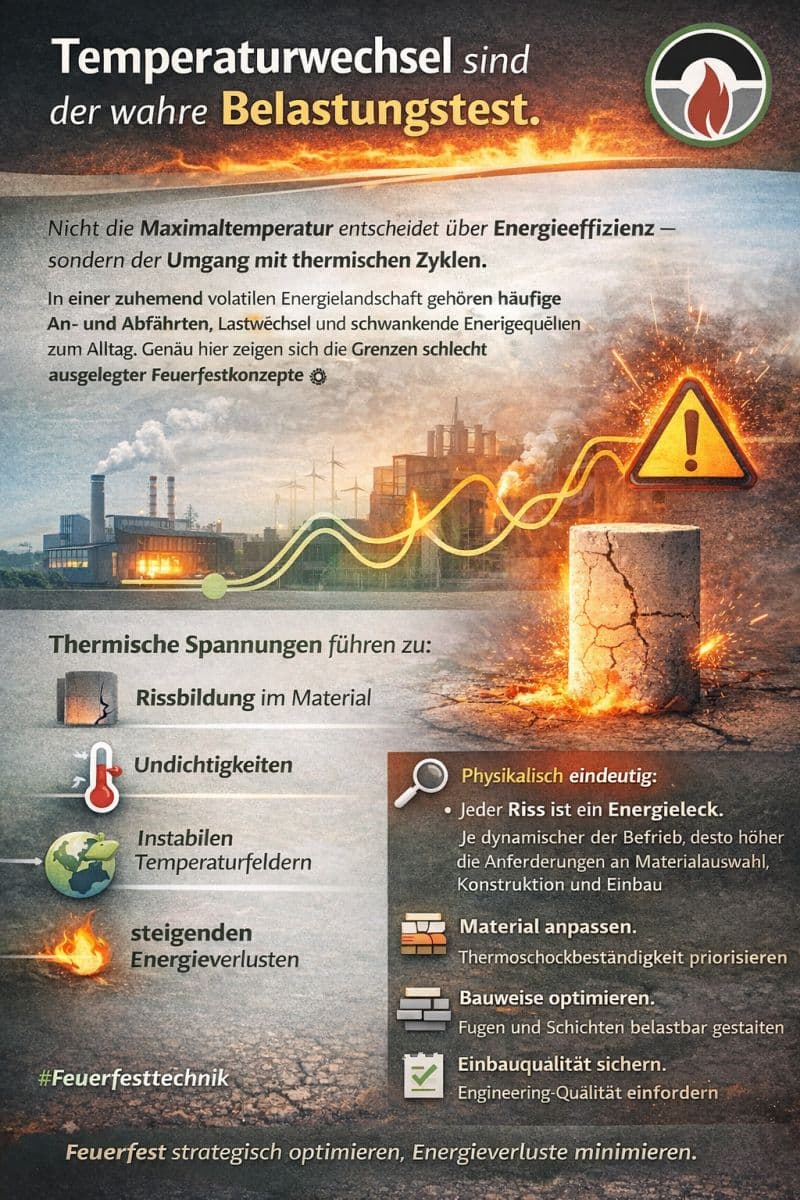
Refractory materials are designed for high temperatures. They withstand 1,200, 1,400 or even 1,800 degrees Celsius without losing their structural integrity. What many operators underestimate is that the greatest enemy of a refractory lining is not the absolute peak temperature, but the repeated change between hot and cold. Every temperature change generates mechanical stresses in the material. The hot side expands while the cold side still has its original dimensions. This differential expansion produces shear stresses that work their way a little further into the material with every cycle.
A refractory material that would last ten years in continuous operation at 1,200 degrees Celsius can fail after just two years if it is cycled daily between 200 and 1,200 degrees Celsius. Thermal shock resistance is at least as important as temperature resistance.
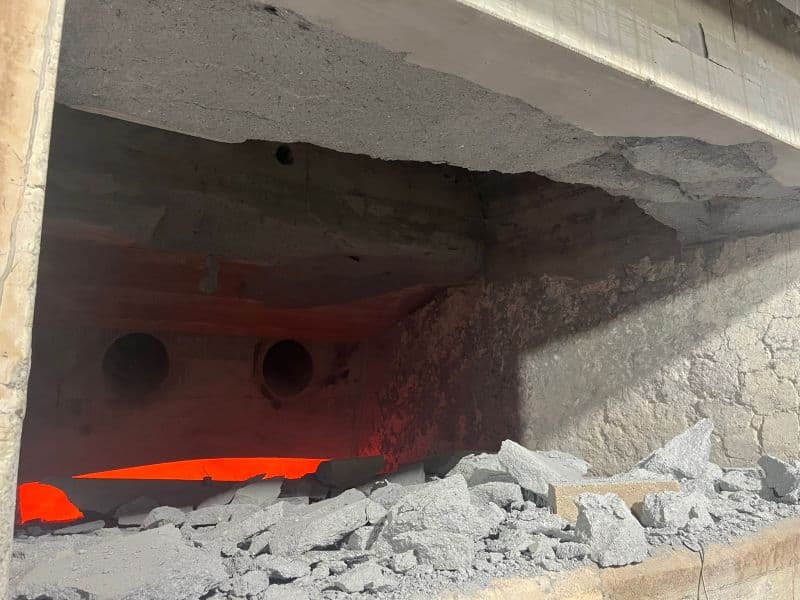
Thermal damage proceeds in several phases. First, fine microcracks form at the surface which are barely visible to the naked eye. With every further temperature change these microcracks grow deeper and join up into a network of cracks that divides the surface into individual segments. At an advanced stage these segments detach from the surface as spalling and the loss of material accelerates exponentially. In technical language this process is referred to as thermal fatigue or thermal shock.
The thermal shock resistance of a refractory material is determined by several material properties: low thermal expansion, high thermal conductivity, high fracture toughness and moderate strength. Materials with a high silicon carbide content or certain phosphate-bonded systems show excellent thermal shock behaviour. The choice of the right material always has to be made in the context of the specific operating conditions: how frequent are the temperature changes? How large is the temperature difference? How quickly do heating and cooling take place?
Besides the choice of material, operational measures can reduce thermal shock loading considerably. Controlled heating and cooling rates are the single most effective measure. Wherever possible, a furnace should never be heated up or cooled down faster than 50 degrees per hour. Avoiding unnecessary shutdowns and optimising charging planning also help to protect the lining. A furnace operated as steadily as possible at a constant temperature achieves the longest service life.
Whether complete relining, repair or emergency — free initial consultation and a fast response.