
Wird geladen...
Wird geladen...
Planning and execution of the complete dismantling of industrial properties including buildings, infrastructure, production plants, foundations and contaminated soils. Main contractor service with a single point of contact.
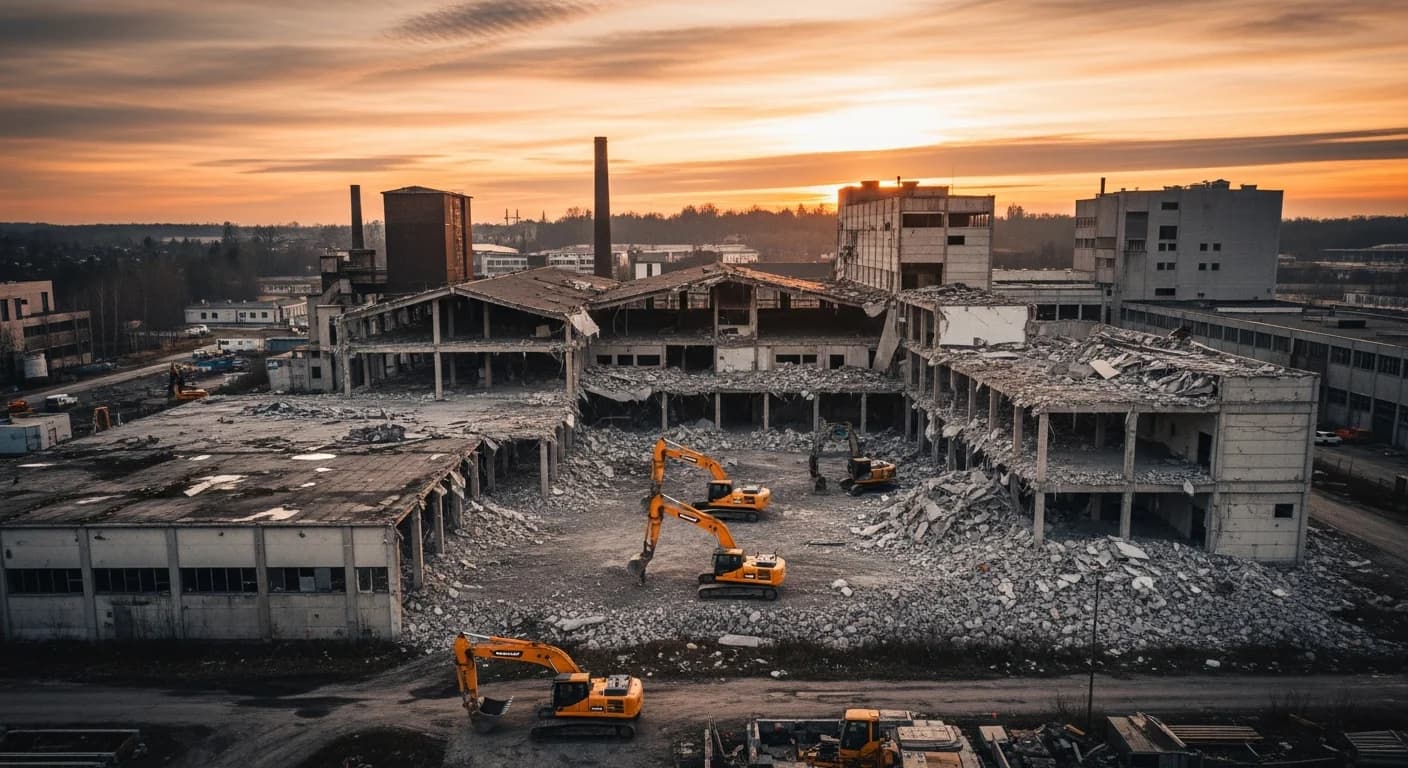
Complete plant dismantling
Dismantling a complete industrial site is a major project that brings together specialist expertise in demolition, hazardous-substance remediation, disposal logistics and coordination with the authorities. Awarding the work piecemeal to individual trades creates interface risks, delays and unplanned costs.
SBS carries out plant dismantling projects as main contractor — with one central project manager as your point of contact. From the preliminary hazardous-substance survey in accordance with DGUV Rule 101-004 through selective dismantling to soil investigation and site clearance, we manage every trade from a single source.
Our advantage: decades of experience in heavy industry mean we know the typical challenges — contaminated furnace foundations, contaminated soils beneath production halls, outdated drainage systems and legacy contamination that only becomes visible during the dismantling.
Proven methods and specialised equipment for optimal results.
Material containing hazardous substances is removed first, followed by the structural demolition. Separating the material streams directly at the structure safeguards recovery rates and prevents cross-contamination.
Long-front excavators with a reach of up to 30 m, hydraulic shears, demolition hammers and concrete crushers for controlled building demolition. Blasting only in exceptional cases.
Central coordination of all trades, scheduling, cost control and communication with the authorities. Regular site reports with a target/actual comparison.
Liaison with the local building authority, the environmental agency, the trade supervisory authority, the water authority and, where applicable, the heritage protection authority. Obtaining all necessary permits and notifications.
Structured, transparent and on schedule — this is how we work.
Survey of the entire site: buildings, infrastructure, plant, soil, groundwater. Preparation of the hazardous substance register.
Historical investigation, preliminary investigation in accordance with the BBodSchV, hazardous substance report. Result: a dismantling concept with a phase plan, cost estimate and permit strategy.
Removal of all materials containing hazardous substances before the structural demolition. Asbestos, MMMF (man-made mineral fibres), PCBs, PAHs, lead paints, contaminated soils.
Clean/dirty changing facilities, negative-pressure containment, clearance measurements. Disposal as hazardous waste with full record-keeping.
Dismantling of all production plants, machinery and technical installations.
Selective disassembly for maximum recovery. Heavy-duty cranes, flame cutting, mechanical dismantling.
Demolition of the building envelopes, halls, administration buildings and ancillary facilities. Processing of the demolition rubble on site.
Mobile crushing plants for concrete recycling on site. Separation of steel and reinforcement. Noise protection and dust suppression.
Removal of the foundations, ducts and underground structures. Soil remediation where contamination is present.
Soil analysis, soil replacement, compaction, ground modelling. Groundwater monitoring where legacy contamination is present.
Final documentation, site clearance by an expert, handover of the development-ready site.
Dismantling report with mass balances, disposal records and recovery rates. Soil clearance in accordance with the BBodSchV.
Proper separation, recovery and disposal of all resulting materials.
Concrete, brick, mortar, tiles. By quantity the largest fraction in building demolition. Processing on site reduces transport costs.
Steel structures, reinforcing steel, machine frames. Magnetic separation and sorting on the construction site.
Excavated material contaminated with mineral oil, heavy metals or PAHs. Analysis determines the disposal route (LAGA Z classes).
Residual materials from building demolition that cannot be separated into pure fractions. Minimised by consistent selective dismantling.
Typical situations in which Complete plant dismantling is used.
Decommissioning of a complete industrial site
Conversion of industrial land into commercial land
Remediation of legacy contamination with subsequent land recycling
Site clearance following insolvency
Dismantling ordered by the authorities
New development planning on existing industrial sites
Everything you need to know about Complete plant dismantling
Your question not listed?
Request a personal consultationWhether complete relining, repair or emergency — free initial consultation and a fast response.