
Wird geladen...
Wird geladen...
Removal of underground structures and infrastructure: machine foundations, furnace foundations, cooling water ducts, containment basins, pits and contaminated soil layers. Including soil replacement, compaction and site profiling.
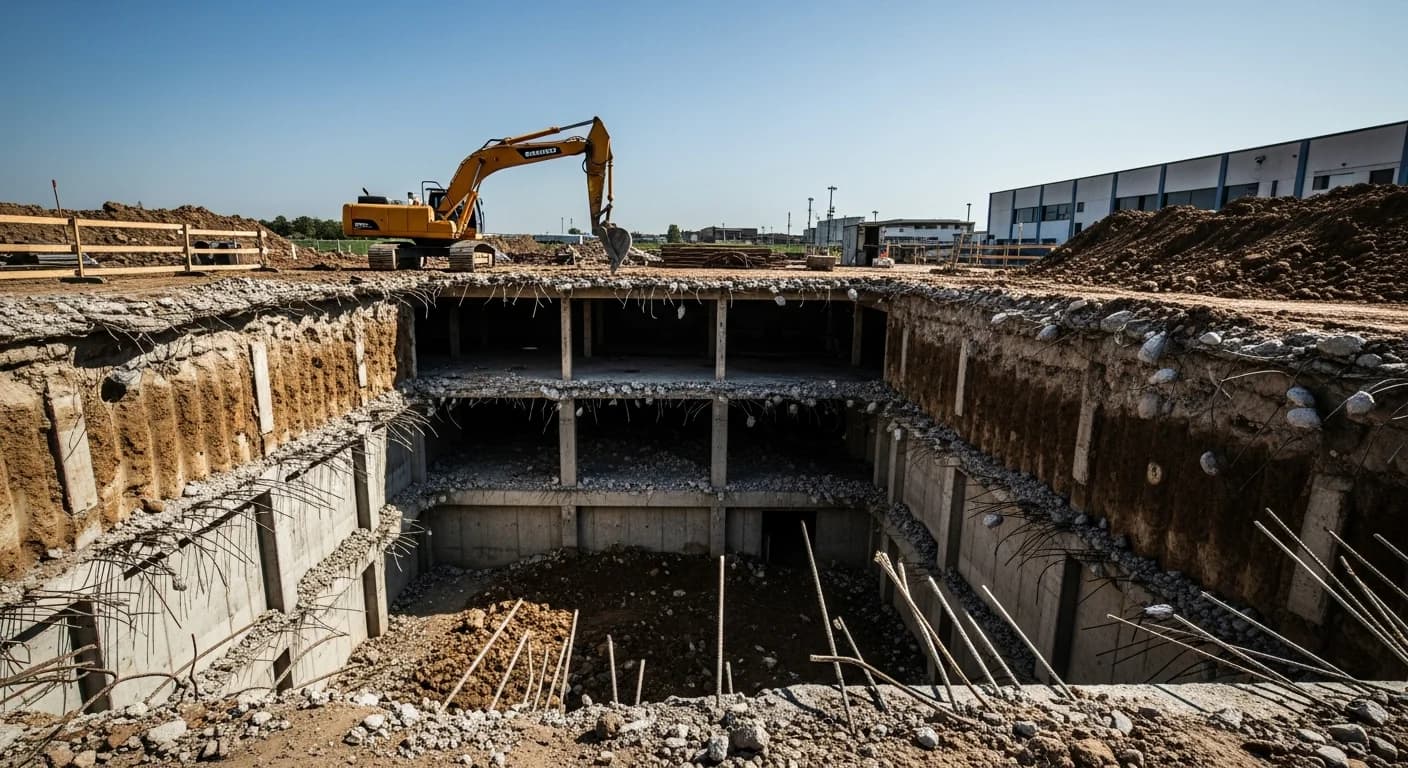
Foundations, ducts, soil remediation
Industrial foundations are not standard components. Furnace foundations carry loads of several hundred tonnes, consist of high-strength reinforced concrete and extend up to 4 metres into the ground. Cooling water ducts, cable trenches and containment basins run through industrial sites as an invisible network.
SBS knows these structures from furnace construction: anyone who dimensions and builds foundations for high-temperature furnaces understands their reinforcement, cast-in components and foundation depth. This knowledge is decisive during dismantling — for the choice of demolition method, the assessment of the load-bearing structure and the avoidance of damage to the subsoil.
A particular challenge in industrial civil engineering is contaminated soil beneath production areas. Decades of use leave behind mineral oil contamination, heavy metal inputs and legacy chemical contamination, which must be assessed analytically and disposed of properly before the soil is replaced.
Proven methods and specialised equipment for optimal results.
Hydraulic demolition hammers and concrete pulverisers mounted on an excavator for the controlled demolition of massive reinforced concrete foundations. Cutting of the reinforcement with excavator-mounted shears.
Excavation of contaminated soil layers and replacement with certified backfill material. Placement and compaction in layers in accordance with ZTV E-StB. Soil analysis determines the excavation depth.
Layer-by-layer compaction of the backfill material with a single-drum roller or vibrating plate. Compaction control by means of the plate load test (DIN 18134) or the dynamic plate load test.
Backfilling of the excavation with suitable material. Site profiling to the client's specifications. Surface left development-ready or prepared for new construction.
Structured, transparent and on schedule — this is how we work.
Survey of the underground structures: foundations, ducts, service lines, pits. Utility line enquiries with the service providers.
Evaluation of as-built drawings and ground investigation reports, and ground-penetrating radar surveys where applicable. Where contamination is suspected: soil samples in accordance with LAGA PN 98.
Excavation down to the top of the foundation. Installation of shoring measures for deep pits and adjacent buildings.
Sheet pile shoring, Berlin-type shoring or benched slopes depending on depth and the space available. Dewatering where required.
Breaking up of the foundation with a hydraulic hammer and concrete crusher. Separation and separate collection of the reinforcing steel.
The concrete is processed on site with a mobile crushing plant or removed as construction rubble (AVV 17 01 01). Reinforcing steel is handled as scrap metal (AVV 17 04 05).
Excavation of contaminated soil layers. Analysis determines the excavation depth and the disposal route (LAGA Z classes).
Sampling of the base and walls of the excavation. Disposal in accordance with the AVV: Z0/Z1 recoverable, Z2 restricted, above Z2 landfill or soil treatment. Documentation for the contaminated land register.
Layer-by-layer placement of backfill material (RC material or gravel). Compaction in accordance with ZTV E-StB. Compaction verification.
Layer thickness max. 30 cm per layer. Degree of compaction Ev2 ≥ 45 MN/m² for trafficable areas, Ev2 ≥ 80 MN/m² for new construction. Plate load test as verification.
Proper separation, recovery and disposal of all resulting materials.
Reinforced concrete foundations, floor slabs and ducts. After processing, usable as RC material in road and pavement construction.
Reinforcing steel (B500) from foundations and floor slabs. Magnetic separation during mechanical processing.
Uncontaminated soil and stones. Recovery in accordance with LAGA M20 as backfill material or in landscaping.
Soil contaminated with mineral oil hydrocarbons (MOH), heavy metals or PAHs. The LAGA Z class determines the disposal route.
Typical situations in which Foundations, ducts, soil remediation is used.
Removal of heavy machine foundations and furnace foundations
Removal of underground ducts and service lines
Soil remediation in the case of mineral oil or heavy metal contamination
Preparing industrial sites for new construction
Removal of containment basins and pits
Site modelling following building demolition
Everything you need to know about Foundations, ducts, soil remediation
Your question not listed?
Request a personal consultationWhether complete relining, repair or emergency — free initial consultation and a fast response.